

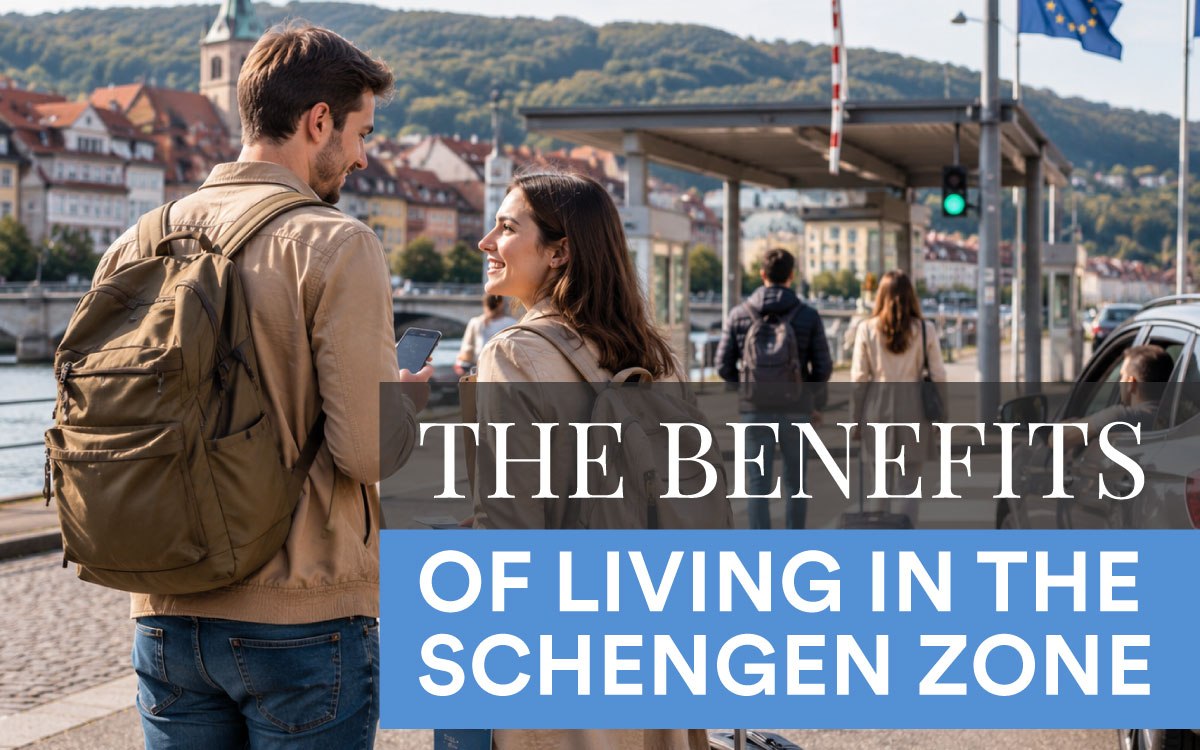
It’s not just a visa category. It affects where you can travel on weekends, how long you can stay, and which job destinations are available to you. Most people hear the word “Schengen” and assume it means “Europe.” It doesn’t. And the difference matters more than most immigration content explains.
I’m Arar Guliyev, founder of Live & Study in Europe. We’ve worked with clients from over 60 countries in Africa and Asia. One of the most common sources of confusion — and disappointment — is Schengen. So here is the honest explanation, in plain language.
What the Schengen Area Actually Is
The Schengen Area is a group of 29 European countries that have agreed to remove passport controls at their shared borders. When you’re inside the Schengen Area, you can travel between member countries the same way you’d travel between cities in your home country — no passport checks, no border queues, no new stamps.
That is the whole idea. It was created in 1985 in a small town in Luxembourg called Schengen, and it has expanded significantly since then.
As of 2026, the 29 Schengen member countries are:
- Austria, Belgium, Czech Republic, Denmark, Estonia, Finland, France, Germany, Greece
- Hungary, Iceland, Italy, Latvia, Liechtenstein, Lithuania, Luxembourg, Malta
- Netherlands, Norway, Poland, Portugal, Slovakia, Slovenia, Spain, Sweden, Switzerland
- Bulgaria and Romania — joined Schengen for air and sea borders on March 31, 2024; land border controls lifted on January 1, 2025, per EU Council decision.
- Croatia (joined January 2023)
Notice something: Norway, Switzerland, Iceland, and Liechtenstein are in this list. None of them are EU members. This is where the confusion usually starts — Schengen and the EU are not the same thing.
Schengen Is Not the EU — and the EU Is Not Schengen
These are three overlapping but different systems: the EU, the EEA, and the Schengen Area. You need to understand all three to make sense of Europe.
The EU (European Union)
A political and economic union of 27 countries. EU citizens have the right to live and work in any other EU country without a visa. As a non-EU worker from Asia or Africa, this right does not apply to you — you need a national work permit for whichever country you work in, regardless of whether it is EU or not.
The EEA (European Economic Area)
A broader economic agreement that includes all 27 EU countries plus Norway, Iceland, and Liechtenstein. EEA citizens also have free movement rights across the EU. Again, as a non-EU, non-EEA worker, this doesn’t apply to you directly — but it explains why Norway and Iceland follow EU-style rules despite not being EU members.
The Schengen Area
A border-control agreement. If you are physically inside the Schengen Area on a valid visa or work permit, you can travel between member countries without being stopped at each border. This is purely about movement — not about working rights, residency rights, or political status.
The practical implication: Norway is not in the EU, but it IS in Schengen. Working in Norway on a work permit gives you Schengen-area travel freedom on your days off. Working in Serbia — which is neither EU nor Schengen — means every border crossing into Schengen countries requires a separate visa and is tracked.
Which Countries Are NOT in Schengen
As of 2026, the notable European countries outside the Schengen Area are:
EU members not in Schengen
- Cyprus — EU member, NOT Schengen. Working toward accession but not yet approved.
- Ireland — EU member, NOT Schengen by choice. Maintains its own visa policy and open border with the United Kingdom.
European countries that are neither EU nor Schengen
- Serbia — EU candidate country, not yet a member of either EU or Schengen.
- Montenegro — officially an EU accession country (opened accession negotiations in 2012); not yet a Schengen member.
- Albania, Bosnia and Herzegovina, North Macedonia — EU candidate countries.
- Kosovo — potential EU candidate (not yet granted official candidate status, blocked by recognition dispute).
- United Kingdom — never a Schengen member (had a legal opt-out from 1999); left the EU in 2020.
If you are working in any of these countries, you are outside the Schengen zone. Visiting a Schengen country from Serbia or Montenegro requires a separate Schengen tourist visa — and it is tracked under the 90/180 day rule.
The 90/180 Day Rule — The Part Nobody Explains Clearly
This rule applies to anyone who is not an EU or EEA citizen. It applies whether you are visiting on a tourist visa or crossing in from a non-Schengen work permit. Understanding it is important — breaking it has serious consequences.
The rule
You can spend a maximum of 90 days in the Schengen Area in any 180-day period. The 180-day window is not fixed — it rolls backward from whatever today’s date is. The system checks: in the last 180 days, how many days were you in Schengen?
A real example
You arrive in Poland (Schengen) on February 1 and stay until April 30 — that is 89 days. You have used nearly all your 90-day allowance. On May 1 you return to Serbia to work. You want to visit Slovakia (Schengen) for a long weekend in June. You can — you have roughly 1 day remaining from the previous 90.
By late July, when 180 days have passed since February 1, your counter begins to reset. But it resets gradually, not all at once. The system is looking backward from every single day.
What does NOT reset the clock
Leaving Schengen temporarily does not reset the clock. Going to Serbia for a month and coming back does not give you a fresh 90 days. The 180-day lookback period keeps running continuously. The only way to genuinely reset is to let enough time pass without returning.
The consequences of overstaying
An overstay in Schengen — even by a single day — is treated seriously. Consequences vary by country and depend on circumstances, but they can include future visa refusals, short-term or longer entry bars, and a permanent record on your immigration history. It affects all 29 Schengen countries. Do not rely on ambiguity — the EES system now records entries and exits digitally with precision.
There Is No Schengen-Wide Work Visa for Long-Term Employment
This is probably the biggest misunderstanding I encounter. People apply to “work in Europe” and expect some single document that covers all of Schengen. For employment purposes, that document does not exist.
For long-term work — anything beyond a short stay — every Schengen country issues its own national long-stay visa (called a Type D visa). A Polish work visa only lets you work in Poland. A Slovak work visa only lets you work in Slovakia. You cannot use a Polish work permit to work in Germany or Austria — even though all three are in Schengen.
A note on short-stay Schengen visas (Type C): these exist and do allow certain business activities — attending meetings, conferences, signing contracts. What they do not allow is employment, meaning you cannot take up a job, receive a local salary, or work under a local contract on a Type C visa. For actual work in Europe, you need a national Type D work visa from the specific country.
Schengen simplifies travel between countries. It does not create a shared labor market for non-EU workers. Each country controls its own immigration and employment separately.
What Schengen DOES give you as a worker in a Schengen country: the ability to travel to other Schengen countries on your days off without needing a separate tourist visa, as long as you stay within the 90/180 day limit for any additional time spent outside your work country.
What This Means for Your Daily Life
If you work in a Schengen country
You hold a national work permit and residency document for that specific country. Within the Schengen Area, you can generally travel to neighboring countries without passport control at land borders — though you still carry your travel documents. Weekend trips to nearby countries, visiting friends in a neighboring city across the border, short holidays — these work simply.
You cannot, however, extend your stay in another Schengen country beyond the allowed period, and you absolutely cannot take up employment in another Schengen country without a separate work permit there.
If you work in a non-Schengen country
Every time you cross into Schengen — even for a day trip — your entry is recorded at the external border. With EES now operational across Schengen from April 10, 2026, this is done digitally using biometrics rather than manual passport stamps. You need a valid Schengen tourist visa (unless your nationality qualifies for visa-free entry into Schengen). Your time inside Schengen counts toward the 90/180 day limit.
You return to your non-Schengen work country using your work permit there — not your Schengen tourist visa. These are separate documents for separate purposes.
The practical difference in one sentence
Schengen makes weekend travel across European borders easier. It does not change your right to work, does not guarantee a higher salary, and does not affect the legality or security of your employment contract.
Does Schengen Mean Higher Salaries?
Not automatically. Salaries depend on the country’s economy and your role, not on whether it is in Schengen.
The specific figures below come from the employer partners we work with, not general labor market averages — actual pay depends on sector, employer, role, overtime, and local tax rules. We share them as a point of reference, not as a market guarantee.
In Norway (Schengen, EEA), the employers we work with in certain non-skilled industrial and food-sector roles offer approximately €3,200 to €4,800 per month net. In Austria (Schengen, EU), our partner employers in healthcare and industrial positions offer approximately €3,200 to €3,500 per month net. These figures reflect the high cost of living in those countries and strong employer demand in specific sectors.
In Hungary (Schengen), our partner employers in seasonal agricultural roles offer around €1,000 per month. In Czech Republic (Schengen, seasonal), the range from our partners is up to €1,100 per month. In Slovakia (Schengen, employment), our partners offer up to €1,140 per month.
In Serbia (non-Schengen), our partner employers offer up to €900 per month — with accommodation and transport typically provided at no cost to the worker, which changes the real take-home picture compared to countries where housing comes out of the salary.
The pattern is not Schengen vs non-Schengen. It is more accurately: Western and Northern Europe vs Eastern and Southeastern Europe. Norway and Austria happen to be in Schengen. Serbia and Montenegro happen not to be. The salary difference is geographic and economic, not a function of border policy.
A Note on Non-Schengen Countries as a First Step
There is a genuine practical argument for non-Schengen European countries as a starting point. The processing times are often shorter — Serbia and Montenegro can take 1–2 months from application to arrival, compared to 3–6 months for most Schengen employment routes.
More importantly, having a European employment record — even from a non-Schengen country — strengthens your profile when you later apply for a Schengen visa or work permit. Embassies and consulates look at your history: do you leave countries when you’re supposed to? Do you have stable employment? Do you have a verified income record in Europe?
A year of clean employment history in Serbia is not meaningless on a future Polish or Slovak application. It is evidence of reliability — which is one of the things embassies assess.
This is not a guaranteed path. Visa decisions are made by embassies, not by immigration companies. But the principle holds: building a European record from a non-Schengen country is a real strategy, not a consolation prize.
What Is Changing in 2025–2026: EES and ETIAS
EES — Entry/Exit System (fully operational from April 10, 2026)
The Schengen Area has launched a new digital tracking system called EES. Every non-EU traveler entering or leaving Schengen now has their fingerprints and facial biometrics recorded electronically at the border. The manual passport stamp is being replaced by this digital record. The system rolled out in phases from October 2025, reaching full deployment across all border points on April 10, 2026.
For workers and visitors from Asia and Africa, this is important: the 90/180 day tracking is now automated and precise. There is no grey area based on unclear stamps. The system knows exactly how many days you have spent in Schengen. Ireland and Cyprus are not part of EES.
ETIAS — Expected late 2026
ETIAS is a pre-travel authorization system for visa-exempt visitors to Schengen — similar to the US ESTA or Canada’s eTA. If your nationality currently allows visa-free entry to Schengen countries, you will likely need to register for ETIAS before traveling. It is not a visa — it is an electronic screening step. The launch timeline has been delayed several times. At the time of writing, it is expected in the second half of 2026.
Frequently Asked Questions
No. A work permit issued by Poland lets you work only in Poland. A Slovak permit covers only Slovakia. Schengen makes internal travel easier, but each country controls its own labor market independently. To work in a different Schengen country, you would need a new work permit from that country.
Yes, if you hold a valid Schengen tourist visa or qualify for visa-free entry into Schengen. Your Serbian or Montenegrin work permit lets you return home after your visit. Time spent in Schengen countries counts toward the 90/180 day rule and is tracked by the EES system.
No. Norway is in the EEA and in the Schengen Area, but it is not an EU member. It follows EU-style rules on free movement and trade, but makes its own decisions on many policy areas. For non-EU workers, a Norwegian work permit follows Norway's national rules — not EU rules.
Not automatically. But it does contribute to your overall immigration profile. Embassies look at employment history, evidence of returning from previous permits, and financial stability. Clean European employment history — including from non-Schengen countries — can strengthen a future Schengen visa or work permit application. It does not guarantee approval. Embassy decisions are independent.
An overstay — even by a single day — is a serious immigration violation. Consequences vary by country and individual case, but can include future visa refusals, re-entry restrictions affecting all 29 Schengen countries, and a permanent mark on your immigration record. The EES system tracks entries and exits digitally with precision — there is no ambiguity. If you are working in a non-Schengen European country and visit Schengen on a tourist visa, count your days carefully.
As of 2026, Cyprus and Ireland are the only EU members outside the Schengen Area. Bulgaria and Romania joined Schengen for air and sea borders on March 31, 2024, with land border controls lifted on January 1, 2025 per EU Council decision. Croatia joined in January 2023. Cyprus is working toward accession; Ireland has an opt-out it has chosen to maintain.
No. A Schengen tourist visa (Type C) explicitly prohibits employment. Working in a Schengen country on a tourist visa — even for a single day — is illegal and can result in deportation and a multi-year entry ban. To work in any European country legally, you need a national work permit or employment visa for that specific country.
The Schengen question is often the first question people ask when they learn about work opportunities in Europe. It is worth understanding correctly — not because one option is definitively better than the other, but because what matters most depends on your specific goals, timeline, and circumstances.
If you want to understand how the Schengen vs non-Schengen choice interacts with the destinations we offer, the processing times, and the realistic salary expectations — that is a conversation worth having before you decide anything.
How useful was this post?
Click on a star to rate it!
Average rating / 5. Vote count:
No votes so far! Be the first to rate this post.